Why do tensions feel sharper when you live abroad?

People settle in another country for very different reasons: a post to take up, a new life, someone they are following, work they could no longer find at home, a country they had to leave. Some really chose it, others much less so. Whatever the reason for leaving, life elsewhere can bring a great deal of happiness.
And yet, after a few months, you catch yourself raising your voice over the shopping, the paperwork, a sentence that came out wrong. You surprise yourself, you don't quite recognize yourself, and you wonder what is going on. Why do we flare up over so little? And why is it so hard to talk about it?
Conflict doesn't change its nature when you cross a border. Couples argue everywhere, sometimes for real reasons, often for reasons that cover up others, and patience wears thin at every latitude. But living elsewhere takes away some of the resources that used to help us absorb it.
A glass that fills up faster

I often use the image of a glass of water as a metaphor for our patience, for how much irritation we can hold. Every annoyance of the day adds a few drops, and the glass fills quietly, without our noticing, until one evening a drop of nothing at all makes it overflow: and we explode.
When you live abroad, the drops fall a little harder. There is the language, of course: getting a medical appointment with a shaky vocabulary, hoping you'll know how to say where it hurts, is no small thing. But the codes, the customs and the ways of doing things differ too, and you move forward without quite knowing how formal to be with people you have just met, or exactly what time it is polite to arrive for dinner. Sometimes it is sillier still: it's the supermarket where nothing is where you expect it, and where it takes you twenty minutes to find the flour. Taken one by one, these are small efforts. Repeated twenty times a day, they start to weigh.
And at the same time, we have fewer outlets for emptying that glass. Before, there was a mother to drop in on who would cook you something good, a childhood friend to go for a drink with, a brother who was always there and understood you without your having to explain, or a colleague to catch your breath with for ten minutes by the coffee machine. Those conversations sometimes solved the problem, or at the very least let us vent and take a step back, and we would come home lighter.
The phone and the internet let us stay in touch these days, of course, and that matters. But it isn't quite the same. The time difference means our friend is asleep at the very moment we need her. Or we dare less: we avoid complaining when we haven't been in touch for two months, we don't want to worry the people we love since we are far away and there is nothing they could do about it. So everything gets poured out in the same place: onto the people we live with, or onto the one friend we have had time to make since we arrived.
Becoming a beginner again in your own life
You were competent somewhere else, and you find yourself no longer knowing how to fill in a form, or how to ask for something without offending anyone. The psychologist Albert Bandura gave a name to what wavers there: self-efficacy, the confidence we have in our own ability to cope. That confidence is built slowly, through repeated successes, and we only notice it the day it fails us. When you settle somewhere else, you become a beginner again in dozens of areas at once. That happens to everyone facing something new; it is just rare to have to relearn everything at the same time, and that particular confidence takes a while to rebuild.
And there is what you left behind without really mourning it: your language, your habits, your bearings, your network, sometimes your professional status. The psychiatrist Joseba Achotegui, who spent years working with migrants and refugees in Barcelona, calls this migratory grief. He developed the idea with people forced into exile, and not all migrations are alike: leaving while knowing you can come back has nothing to do with fleeing a war. But the idea remains illuminating at every scale, because even a chosen and happy departure requires adaptation, and that adaptation uses up energy you hadn't planned for.
When the move is for one person's job
There is a particular imbalance among couples who move for one partner's position. A survey conducted by Expat Communication among nearly three thousand people who followed their partner abroad is telling: in nine cases out of ten it is the woman who follows, and almost one spouse in two feels they have sacrificed something.
When both partners were working before the move, one of them suddenly becomes financially dependent on the other, which creates an asymmetry in the relationship, however much goodwill there is on both sides. This isn't about the value of what either of them does, because running a household, raising children and settling a family into a foreign country is considerable work. It is about the autonomy that has been lost, about the sudden change of status that can make us question our place in society. No longer having your own income, having to ask for money, no longer deciding on your own what you spend when you were used to being independent in that respect, is hard, even in a couple where no one ever says a word of reproach. And for some people, that life doesn't match the idea they had of their own fulfilment. There is also something subtler, almost trivial, that comes up at every new encounter: "And you, what do you do?" Answering "I'm here with my husband" costs more than it seems.
A trap then forms that neither of them escapes easily. The one who isn't working seems to have an easy life (no alarm clock, no boss, no commute) and therefore feels in no position to complain. The one who is working is exhausted, carries the household income, and feels just as unentitled to complain, since the whole move was made for their career. Both feel misunderstood, and neither allows themselves to say so. That is where, in what goes unsaid, my work as a mediator begins.

Three simple habits
Before it comes to mediation, there are things anyone can do at home.
Check before interpreting. We spend our time attributing intentions to other people: he did it on purpose, she doesn't care, he has no respect for me. These conclusions form in a second, without our really choosing them, and they are wrong half the time. Simply asking "when you said that, what did you mean?" defuses a surprising number of arguments before they even begin.
Talk about yourself rather than the other person. A sentence that starts with "you" usually announces a reproach, and therefore calls for a defence, whereas a sentence that starts with "I" leaves room for conversation. The idea is simple: state the fact, without judging it, say what it does to you, say what you need, and finish with a concrete request. That last point is the one we almost always forget, because we readily express a reproach and very rarely a request.
Name your tiredness instead of making the other person carry it. Saying "I'm worn out tonight, it's not about you" takes three seconds and often saves two hours of tension. It is also a way of acknowledging that your glass is full, which remains the best way of not spilling it over someone who has nothing to do with it.
When you can no longer talk to each other
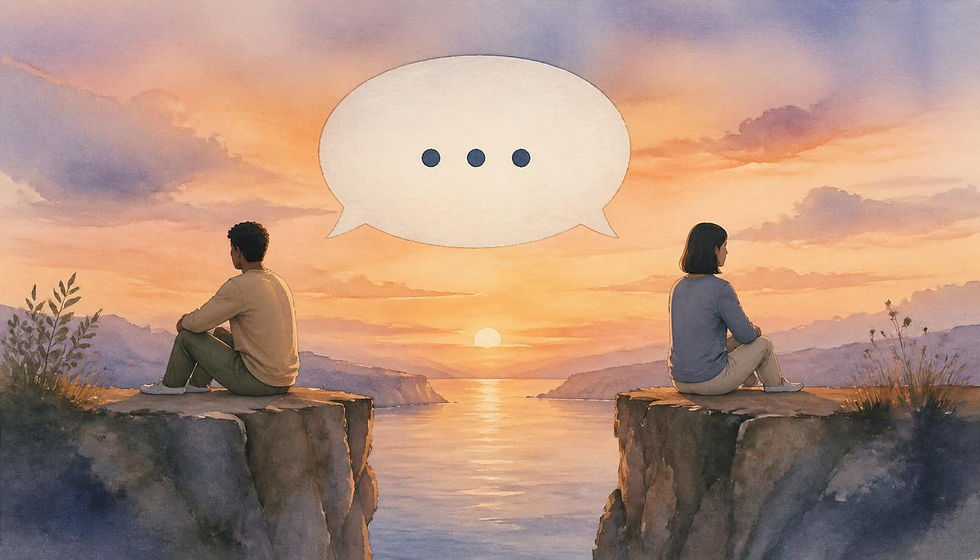
Sometimes these habits are no longer enough, and a conversation has become impossible between two people. Each of them knows in advance what the other is going to say, the same sentences have been going round for months, and in the end you give up saying them.
That is the moment when a third person can help. In mediation, I set a safe and respectful framework, I make the dialogue possible, and I help each person clarify what they need and put their requests into words. It is the people themselves who decide what is discussed and what solutions they keep, and who stay at the centre of the process. Everything starts with individual meetings, because no one should find themselves facing the other person without having been prepared for it.
Two particular obstacles remain when you live abroad: language and distance. You can do your shopping in the local language, work in English, joke with your neighbours, and none of that says anything about your ability to express what hurts. Our emotions took shape in our mother tongue, with the words of our childhood and the nuances that don't translate. Explaining what you feel in a language you learned later, you end up saying "annoyed" when you meant hurt, humiliated, or simply exhausted, and eventually you give up being precise. A whole range of emotions gets reduced to a single word, and the other person can't guess what was behind it.
That is why I think it matters that listening and mediation should be available in your own language, wherever you live, online as well as in person. No one should have to choose between asking for help and being properly understood.
What stays in our hands
Living abroad doesn't make our relationships more fragile. It exposes them more, quite simply, because we spend more time together, with fewer of our own people around and a little more tiredness in the body.
But there is one thing that doesn't change from one country to another: the way we react to other people belongs to us. That is slightly uncomfortable to hear, since it gives us a share of the responsibility, but it is above all excellent news, because we can only act on what depends on us, and there is always something to be done.
Acknowledging that your glass is full, checking before interpreting, making a request rather than a reproach: these are small things, and they are often enough to get things moving again where everything seemed stuck.
If tensions and things left unsaid are weighing on you, do consider mediation. I work with people online and in Valencia, in French and in English, with attentive listening and empathy, and I also run individual anger-management workshops.
Wondering whether mediation fits your situation? Book a free first conversation here.


Comments